
介紹
Office managers are facing a new challenge.
Employees come into the office expecting more than just a hot desk. They need quiet spaces to focus, private spots for video calls, and flexible areas for small team sessions, all in a single shared environment.
Open-plan layouts were designed for collaboration. But they often come at the expense of concentration, privacy, and employee wellbeing.
This is where work pods come in.
In this guide, we cover everything managers need to know about work pods: what they are, why they matter, the key benefits, and how to integrate them effectively into a hybrid workplace.
What Is a Work Pod?
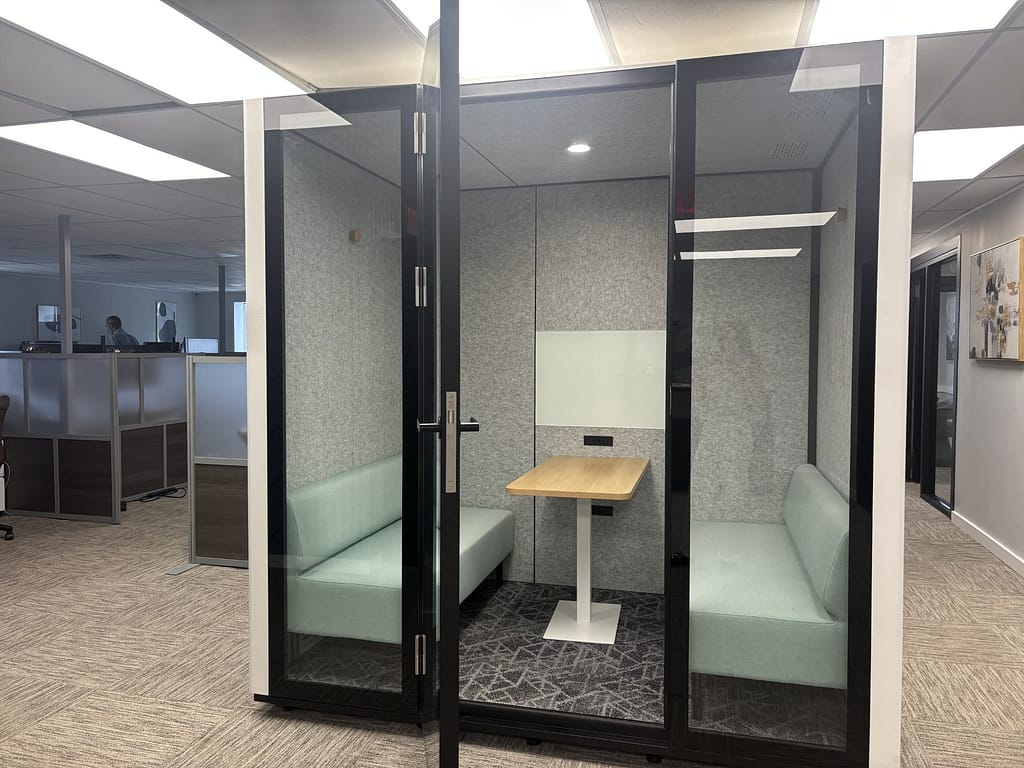
一種 work pod is a self-contained, sound-insulated workspace designed to provide privacy within an open office environment.
Depending on the model, work pods can be used for:
- Individual focused work
- Video and phone calls
- Small meetings (2–4 people)
- Confidential conversations
They function as modular “rooms within a room”, allowing companies to create private workspaces without permanent construction.
Why Work Pods Matter
The Productivity Problem
Open-plan offices were built with collaboration in mind. But noise, constant interruptions, and the absence of private spaces take a real toll on employee performance.
Research by the International Workplace Group found that 85% of employees believe access to quiet zones significantly improves their productivity. Yet in most open-plan offices, those quiet zones simply don’t exist.
Work pods solve this problem directly.
The Hybrid Work Factor
The rise of hybrid work has changed how offices are used. Employees no longer come in every day, and when they do, they expect the office to be worth the commute.
That means having access to:
- Private spaces for video calls
- Quiet areas for deep work
- Flexible zones for on-demand collaboration
Work pods provide a simple, scalable answer to these evolving needs.
6 Key Benefits of Work Pods
1. No Construction Required
Building a new meeting room is slow, disruptive, and expensive. According to Dezeen, constructing a meeting room costs 55% more than purchasing an office pod.
Work pods require no contractors, no permits, and no downtime. Most can be fully installed within a few hours.
For office managers who need to respond quickly to changing team needs, this is a major advantage.
2. Significant Cost Savings
The financial case for work pods is well documented.
Research by Framery and CBRE estimates that replacing meeting room construction with office pods could save US companies approximately $30 billion by 2030.
Unlike permanent renovations, which are sunk costs, work pods are classified as movable, depreciable assets. This is a meaningful distinction when making the case to finance and leadership.
3. Flexibility to Adapt Over Time
Work pods are modular by design. They can be moved, reconfigured, or relocated as your office layout evolves.
Downsizing a floor? Move the pods. Onboarding a new team? Add more booths. Redesigning your layout? Reposition in hours.
This flexibility makes work pods an ideal solution for organizations managing hybrid teams, where office occupancy changes week to week.
4. Measurable Impact on Productivity
Noise and distraction are among the leading causes of lost productivity in open offices.
Work pods create a dedicated acoustic environment where employees can concentrate fully, whether they are writing a report, joining a client call, or working through complex analysis.
The impact is measurable. Organizations that implement wellness-focused design see a 32% decrease in employee absenteeism and a 23% boost in job satisfaction, according to the Global Wellness Institute.
5. Better Employee Wellbeing
What employees consistently say they need most is privacy. When that is missing, it does not just affect output, it creates stress, fatigue, and burnout.
Work pods give employees a space to step away from the noise when they need it. A place to focus. A place to breathe.
For office managers, this translates into a healthier, more engaged workforce.
6. A More Sustainable Office Investment
Work pods require far less material than traditional construction. They generate minimal installation waste, and many models are built with recyclable or low-emission components.
They can also be disassembled and reused in new locations, rather than demolished when the office changes.
For organizations with ESG commitments or green building targets, this matters.
Types of Work Pods: Finding the Right Fit
Not all work pods are the same. The right choice depends on your floor plan, team size, and how employees use your space.
Single-person focus pods are the most common starting point. Compact and efficient, they are ideal for individual deep work, phone calls, and confidential conversations. They take up minimal floor space and can be distributed across an open floor for easy access.
Two-to-four person meeting pods are larger enclosures suited to small team huddles, interviews, or client calls. They offer a cost-effective alternative to booking a full meeting room for a 30-minute conversation.
Wellness pods are a newer category, quieter, softer spaces designed for mental health breaks, rest, or moments of calm. They are increasingly popular in organizations that treat employee wellbeing as a strategic priority.
When evaluating options, office managers should look for:
- Acoustic performance (STC rating)
- Ventilation quality
- Power and connectivity options
- Compatibility with booking systems
- Lead time and ease of installation
How to Integrate Work Pods Into Your Hybrid Workplace
Installing work pods is only the first step. For them to deliver their full value, employees need to find and book them easily — without friction.
Work pods are not a trend. They are a practical, proven response to a real challenge: offices that do not support the way modern employees actually need to work.
Looking to upgrade your office with modern work pods?
👉 聯絡我們 today to discover flexible, high-performance workspace solutions tailored to your needs.
關於FLYDESK
FLYDESK 是一款創新的混合辦公室管理軟體,旨在幫助企業提高生產力、優化工作空間利用率並增強團隊協作。 FLYDESK 專為採用靈活辦公模式的公司而設計,可簡化遠距辦公和辦公室協調,從而更輕鬆地管理團隊和資源。了解 FLYDESK 如何協助您革新混合辦公環境並提升營運效率。 聯絡我們 今天就來了解更多!
