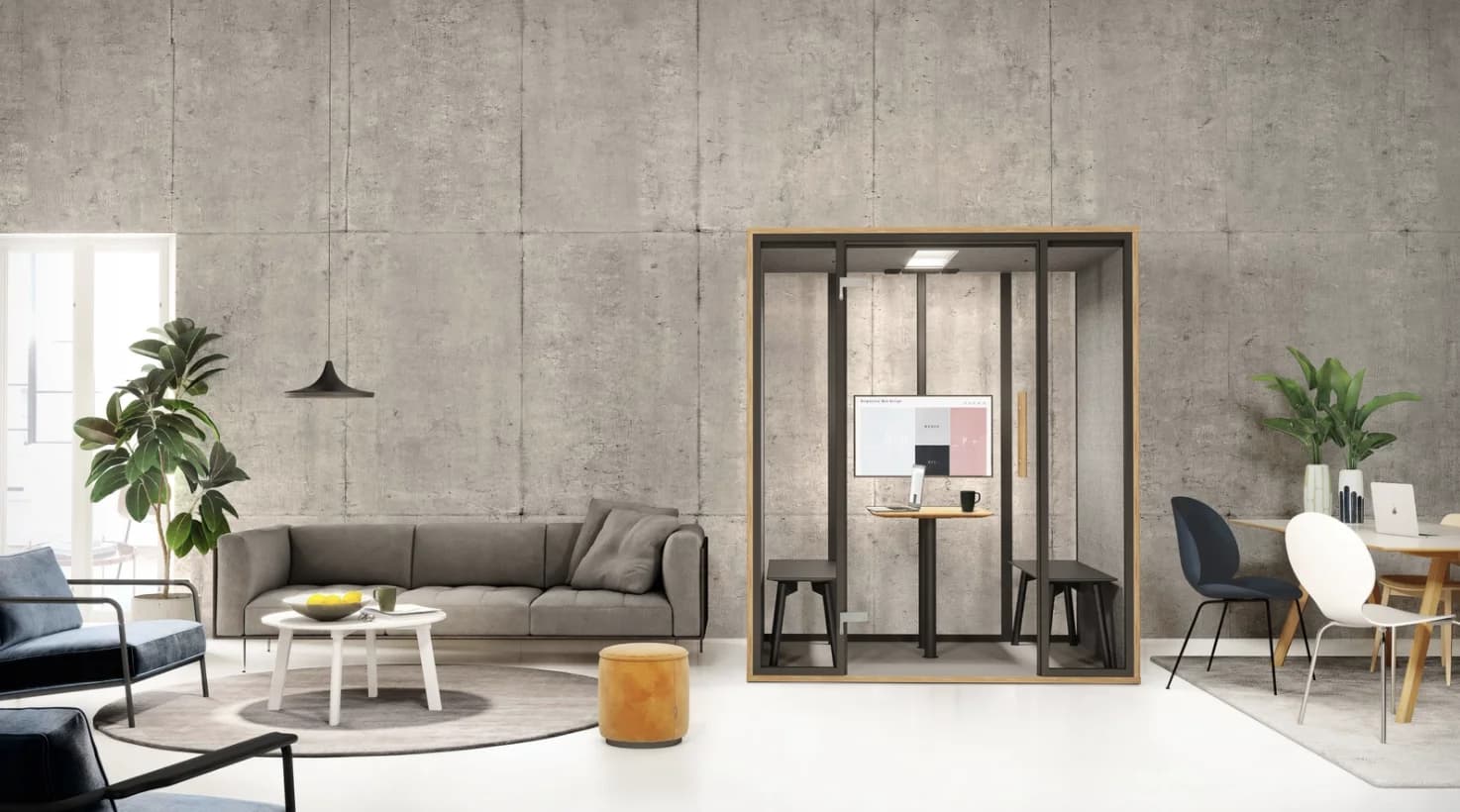
An office may lack places for calls while larger meeting rooms sit partly occupied. Identify that specific mismatch before buying pods. A local trial is more useful for the decision than broad productivity percentages or a forecast for the whole market.
Make day-to-day use practical
Agree how people find an available space, the expected session length, cleaning and fault reporting. Check whether solo calls would occupy a pod needed for meetings. Review accessibility with intended users rather than assuming that a compact footprint or a wide-looking door is sufficient.
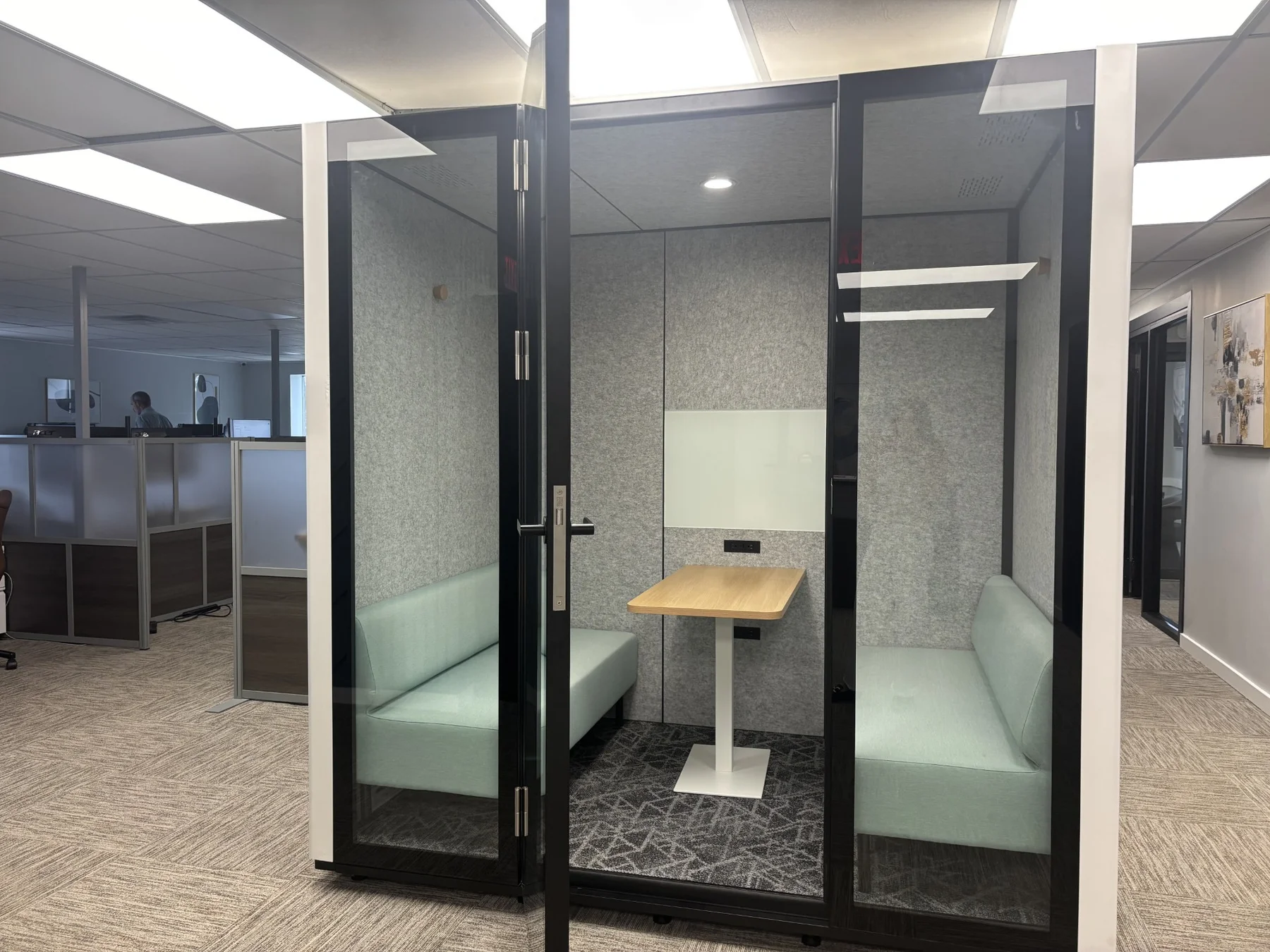
Image retained from the original article; it does not establish the specification or included equipment of a current FLYDESK model.
Use a defined trial and an honest comparison
Record unmet room demand, interruptions and available space before the trial. Afterwards, compare use, waiting time, call quality and user feedback over a comparable period. Account for changes in staffing and work patterns; an improvement observed after installation does not by itself prove that the pod caused it.
Document assumptions in the business case
Compare equivalent usable capacity over the same period, including installation and running costs. State the expected utilization and test a lower-use scenario. Ask the organization’s finance advisers how the actual contract and local rules affect accounting; do not assign a universal depreciable-asset treatment.
Set a bounded objective for wellbeing
Ask users about comfort, concentration and preferred work settings. Do not present a booth as a treatment for stress or a proven way to reduce burnout or absence. Space choices sit alongside workload, breaks, management practices and individual needs.
Test speech privacy in the intended setting
Ask for the test report for the complete proposed enclosure and its test conditions. Try ordinary speech and a call with the door closed, listening both inside and outside. Sound reduction does not establish complete isolation or guarantee that a confidential conversation cannot be overheard.
Confirm the site before ordering
Have the supplier and responsible site professionals check delivery access, floor loading, ceiling clearance, door swing, escape routes and electrical provision. Confirm applicable permissions, fire-safety and accessibility arrangements locally. Do not budget on universal permit exemption or installation without disruption.
Demonstrate any booking or access connection
A FLYDESK pod can be purchased independently of the FLYDESK app. If booking, occupancy sensing or digital access matters, request a demonstration, supported system details and written responsibilities for setup and maintenance. Do not assume an app integration merely because both products carry the same brand.
Keep capacity tied to the selected model
FLYDESK presents Solo for one person and the Meeting family for up to six, with Standard and XL formats. This family-level maximum does not assign six places to every configuration. Confirm the selected layout, occupied capacity and clearances in the quote.
Put acceptance criteria in writing
Before commitment, agree the configuration, layout, included equipment, delivery schedule, installation responsibilities and support. At handover, check doors, lighting, power, ventilation and any demonstrated digital functions. Record issues and the remedy process before treating the installation as ready for use.