Key takeaways
- A controlled study, a customer account and a policy announcement provide different kinds of evidence. Do not treat them as interchangeable proof of success.
- Choose a model around the work: coordinated office days, a fixed weekly pattern or remote-first work with planned gatherings.
- Make team overlap and space availability visible before people choose their office days.
- Evaluate delivery, employee experience and peak space demand together, not attendance alone.
What makes a useful hybrid work case study?
An effective hybrid work model connects where people work with the tasks, colleagues and space they need. A famous company's attendance rule is not enough to design yours. These four cases compare a customer implementation, a randomized trial, a company's internal evaluation and a policy change. They are examples to learn from, not a ranking of employers or a claim that every model has proved equally effective.
The company examples below are dated accounts. Their arrangements may change by role and location. The practical recommendations are our interpretation of the evidence, not results promised by the companies or by FLYDESK.
1. Native Union: a customer account of hybrid working
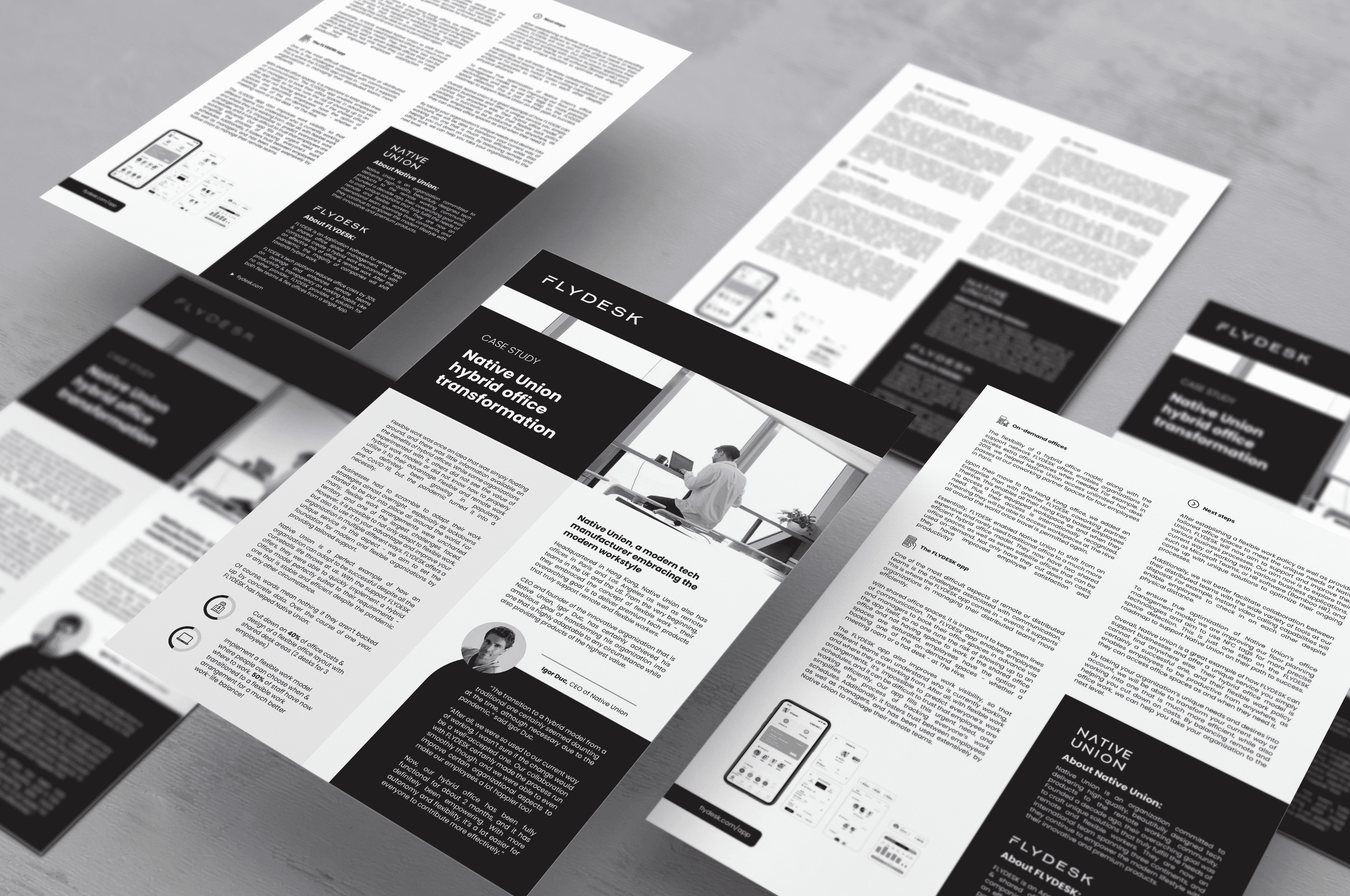
In its April 2024 article about its partnership with FLYDESK, Native Union describes using workplace scheduling to share office and remote days with colleagues and coordinate calendars. The company also describes using desk booking and shared desks to manage available office space.
Read Native Union's own account below for the customer's description of its experience.
2. Trip.com: test a defined weekly pattern
A randomized trial published in Nature in 2024 studied 1,612 graduate employees in Trip.com's airfare and IT divisions. The experiment compared a schedule with two home-working days per week against full-time office working. Attrition was 4.8% in the hybrid group versus 7.2% in the control group, a one-third relative reduction. The researchers found no damage to performance.
This is stronger evidence about that tested arrangement than a satisfaction survey alone. It is not proof that every role, employer or number of remote days will produce the same result. The population and the fixed schedule matter.
The transferable lesson: define the arrangement precisely, choose success measures before launch and compare outcomes. Keep a stable baseline instead of judging a policy from one unusually busy or quiet week.
3. Dropbox: remote-first does not mean never meeting
Dropbox's review of 2024, published in March 2025, describes its Virtual First approach and planned in-person gatherings. It distinguishes offsites, retreats and coworking sessions by their purpose. It also reports experiments with asynchronous documentation and cross-functional Anchor Weeks.
These findings are Dropbox's own evaluation, not a randomized comparison with office-first companies. Their value here is the operating detail: a distributed model still needs deliberate coordination, preparation and a budget for meeting in person.
The transferable lesson: start each gathering with an outcome, an audience and the work to be completed. A decision workshop needs different participants and space from onboarding or an individual focus day. Do not copy an offsite calendar without checking travel burden and accessibility.
4. Microsoft: make policy scope and exceptions explicit
In September 2025, Microsoft announced a move towards three office days per week. The announcement set a first phase for Puget Sound employees within 50 miles of an office by the end of February 2026, with later phases elsewhere and exceptions or business-specific arrangements.
This is evidence of a policy decision, not a published causal test proving that three days outperforms two. It also makes older descriptions of unrestricted location choice a poor guide to the company's announced approach.
The transferable lesson: write down who a policy covers, when it takes effect, how exceptions work and who resolves conflicts. A single headline number leaves unanswered questions about travel, team alignment and office capacity.
Turn the cases into a policy your team can test
Use the examples to make a small number of explicit decisions. Start with one team or a clearly defined group, and choose a review period long enough to include its normal delivery cycle. Treat the following as a planning checklist, not a validated scoring system.
- Work: list the activities that benefit from being together and those that require uninterrupted individual focus.
- People: identify which colleagues must overlap, including cross-functional partners and new starters.
- Location and time: set these separately. A remote-capable role may still need shared collaboration hours.
- Space: test the busiest realistic day, including meeting rooms and quiet areas, before changing desk capacity.
- Exceptions: name the decision owner and provide a clear route for individual requirements.
- Review: compare delivery quality, employee feedback, missed collaboration and actual space demand against the baseline.
A worked example: why the weekly average is not enough
Consider an illustrative 40-person team using a 24-desk office. Planned attendance from Monday to Friday is 12, 32, 28, 16 and 8 people. The weekly average is 19.2, below capacity, but Tuesday needs eight more desks and Wednesday needs four. These are invented planning numbers, not customer results.
The first question is whether the overlapping days are necessary for shared work. If not, teams can coordinate different days. If they are, consider a suitable overflow arrangement or more capacity. Do not force attendance into a spreadsheet target at the expense of the work the office day is meant to support. Compare a revised schedule with the same five-day capacity check before changing the lease or desk count.
Which model should you choose?
For a team whose collaborators live near the same office, a predictable shared pattern may be worth testing. For a geographically distributed team, remote-first routines plus purposeful gatherings may be more workable. Where schedules vary, visibility and booking help people coordinate, but cannot replace a clear agreement about why they are meeting.
Use the hybrid work diagnosis to clarify location and time flexibility. Then model office demand separately. The right model is the one you can explain, operate and evaluate for your team, not the one attached to the best-known company name.