Start with the work that needs to happen, rather than a target number of office days. Identify customer-facing and site-dependent roles, shared tasks and individual focus work. Explain which decisions are common to the company and which teams can adapt, with a clear process for exceptions.
Read surveys with their dates and populations
McKinsey's 2022 American Opportunity Survey reported that 87% of employed respondents offered remote work took that opportunity. This is not a claim that 87% of all employees worldwide prefer remote work. Gallup's May 2026 figures concern U.S. employees in remote-capable jobs: 52% hybrid, 26% fully remote and 22% on-site. These describe working arrangements, not a universal preference or an ideal staffing ratio.
Agree when being together is useful
Ask teams which activities benefit from shared presence: onboarding, workshops, sensitive conversations or access to equipment. Agree overlap and notice periods while considering time zones, commuting and accessibility. Make information and decisions available to absent colleagues. A hybrid schedule can create coordination costs as well as flexibility; test the arrangement rather than guaranteeing productivity or cultural connection.
Plan capacity before changing the space
Look at daily peaks, room types, accessible desks and equipment, not only average attendance. Test reservations and cancellations with the people who will use them. Lower occupancy does not automatically reduce rent: savings depend on leases, fit-out costs and expenses that can actually be avoided. Retain enough capacity for the activities the policy requires.
Support the process and review the results
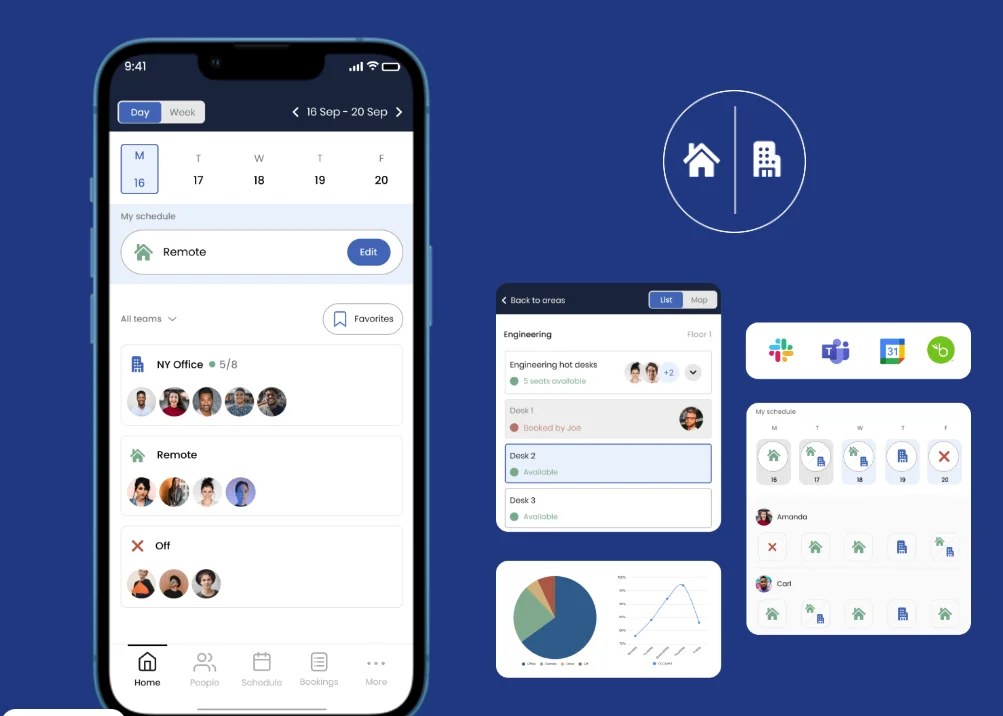
FLYDESK supports workplace planning and desk booking. Define responsibilities for schedules, exceptions and support; keep communication channels explicit instead of assuming that a booking tool replaces them. Set a baseline, a review date and a small set of task, coordination and space-use measures. Combine those with employee feedback and explain how data is used. Adjust the plan when it fails to meet a specific need.
Sources checked on 2026-10-10: McKinsey — American Opportunity Survey, 2022 · Gallup — May 2026
Original illustrations are retained for historical context, not as verified current statistics or a list of available product functions.