Key takeaways
- Financial payback needs identifiable net cash benefits.
- Compare alternatives that meet the same needs.
- Track workplace benefits separately from cash savings.
Start with a problem, not a promised payback period
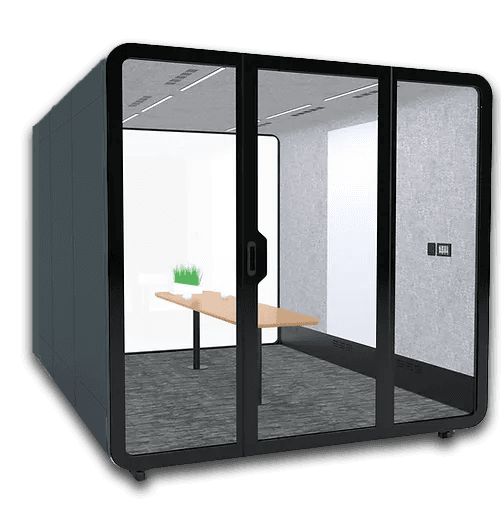
A phone booth may give people a dedicated place for calls, but that alone does not establish a financial return. Define the problem first: repeated paid room hire, a shortage of call spaces, or a planned fit-out that could be redesigned. Different problems need different comparisons.
This guide provides a planning method, not a vendor quote or a customer result. The numerical example is entirely illustrative. It does not predict a return for your office and is not a discounted cash-flow or tax analysis.
Count the complete installed cost
Ask for a quote covering the exact model, furniture, delivery, assembly and required site work. Put all options on the same currency and tax basis. Record exclusions and ask who pays if delivery access differs from the original assumption.
Manufacturer starting prices are not necessarily complete installation budgets. Framery's One Compact pricing notes separate delivery and installation from the starting price. ROOM provides separate delivery and assembly preparation guidance. These illustrate why quote scope matters, not a universal installation time or manufacturer endorsement.
Identify spending you can actually avoid
A cost belongs in the cash-benefit calculation only when the decision will genuinely reduce it. External room hire that you can stop buying is different from allocating a share of rent to a space inside an unchanged lease. Using fewer square metres does not itself reduce the rent invoice.
Compare equivalent activities and capacity. Check whether a booth can accommodate the calls you otherwise pay for; do not include workshops or large meetings it cannot replace. Avoid counting a cancelled expense twice under both room-hire savings and staff-time savings.
An illustrative payback calculation
Assume a fictional installed cost of 8,000 currency units. Suppose documented, cancellable room-hire spending falls by 300 per month, while extra cleaning, electricity and servicing total 50 per month. The net monthly cash benefit is 300 minus 50, or 250.
Simple payback is installed cost divided by positive net monthly cash benefit: 8,000 / 250 = 32 months. Over 36 months, net cash benefits total 9,000. After the initial 8,000 cost, the surplus is 1,000 and the simple period ROI is 1,000 / 8,000 = 12.5%.
This assumes the same benefit every month, no financing cost, no discounting, no residual value and no additional tax effects. Replace every input with your own evidence. Refurbishment or replacement during the period also changes the result.
Test the downside before approving the purchase
If avoidable monthly spending is only 150 and extra operating cost remains 50, the net benefit is 100 and payback becomes 80 months. If no spending is avoidable, the pod may still have workplace value, but there is no positive cash payback under this model.
For a decision horizon shorter than the calculated payback, show that gap clearly. Compare conservative and expected cases and explain the assumptions. Do not replace missing evidence with a claim that booths pay for themselves within a few months.
Keep workplace outcomes visible, but separate
Call-space availability, user comfort and fewer failed room searches can matter even when they do not reduce a cash expense. Set a baseline, collect feedback and check use for intended activities. Reservations are not proof that every booked minute was occupied.
Do not multiply a speculative productivity percentage by payroll and present it as money saved. If you estimate time released, show the method, uncertainty and how that time might be used. Satisfaction or retention improvements need separate evidence; they cannot be assumed from a purchase.
- Before purchase: record the space problem, alternatives and quote scope.
- During a trial: observe suitability for intended calls and gather feedback.
- After installation: compare actual avoidable spending and operating costs with assumptions.
- At review: update the scenario and adjust location, booking rules or equipment where needed.
Make the decision on a transparent business case
Use cash payback where a real expense can be removed. Where the aim is a better workplace experience, describe it honestly and choose measures that test it. A credible business case can contain both benefits without pretending they are the same.
FLYDESK offers a commercial Pods enquiry route. Request a location-specific quotation and compare alternatives using the same assumptions; no return on investment is promised.